Custom Plow Shovels & Shares Manufacturer
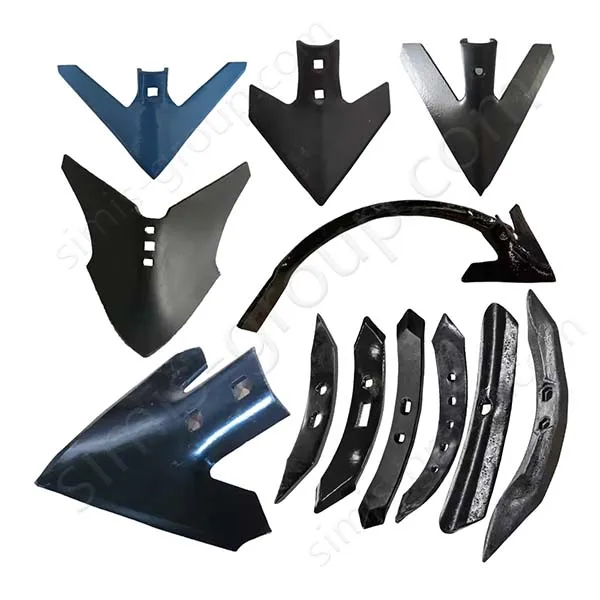


Plow Shovels & Shares

Custom Plow Shovels and Shares: OEM Manufacturing FAQs
Can SIMIS manufacture custom plow shovels and tillage sweeps from our drawings?
Yes. SIMIS supports OEM manufacturing of custom plow shovels, plough shares, cultivator sweeps, tillage points and related agricultural ground-engaging parts according to customer drawings. Depending on the material, blade geometry and production quantity, the manufacturing route may include steel forging, steel casting, cutting and forming, heat treatment, mounting-hole machining and protective finishing. Each project is reviewed against its soil-working geometry, attachment interface and inspection requirements.
Is forged steel or cast steel better for agricultural plow shovels?
Forging is a candidate for suitable steel shovels and points requiring a particular combination of toughness, strength and shaped geometry. Steel casting may be practical for complex or thicker ground-engaging parts where the selected alloy and casting design meet the operating requirements. Cut and formed steel plate is another important manufacturing option for many relatively thin tillage sweeps and shares. The choice depends on thickness, geometry, soil conditions, material grade, tooling and production volume.
Which materials provide wear resistance for plow shares and sweeps?
Carbon steels and selected alloy steels, including suitable boron-alloyed grades, may be used for agricultural wear parts when their composition and heat-treated condition are properly specified. High-manganese steels and other wear-resistant alloys may be considered for particular impact and abrasion conditions. Greater hardness does not always mean better field life: the required balance between abrasive wear, chipping resistance and toughness depends on soil composition, stones, operating speed and the actual blade design.
Can mounting holes, square openings and blade profiles be customized?
Yes. Custom features may include round bolt holes, square carriage-bolt openings, slotted holes, multiple mounting patterns, formed wings and special cutting-edge profiles. Depending on the manufacturing route, holes may be punched, formed, drilled, broached or otherwise finished as specified. The final hole spacing, attachment angle and contact surfaces must match the customer's shank or plow-body assembly.
What information is required for a custom plow shovel quotation?
Please provide 2D drawings and available 3D models, blade width and length, material grade, thickness, cutting-edge geometry, mounting-hole pattern, required hardness or heat-treated condition, surface finish and order quantity. Information about the mating agricultural equipment, soil type, stone exposure and expected operating conditions is helpful when reviewing manufacturing feasibility. If the part is a replacement component, a physical sample may also help identify its geometry, subject to drawing confirmation.
OEM Custom Plow Shovels, Plough Shares and Tillage Sweeps
Plow shovels and shares are ground-engaging agricultural components used to penetrate, loosen, cut or move soil as part of a tillage machine. Depending on their profile, they may work as a narrow point, a wide sweep, a plowshare or another replaceable soil-working tool. Their cutting geometry and attachment positions are developed around the complete implement, not simply the appearance of an individual blade.
During field operation, these parts contact soil particles, stones, plant residue and other abrasive materials. Loads can change with soil moisture, working depth, machine speed and unexpected obstacles. The design must therefore consider edge wear, bending, local impact, fastener retention and adequate clearance from surrounding equipment.
SIMIS supports drawing-based production of metal tillage components with custom cutting profiles and mounting features. The manufacturing approach is selected according to the customer specification and can be coordinated with related agricultural machinery castings and forgings requirements.

Types of Custom Soil-Engaging Plow Shovels and Shares
Agricultural equipment manufacturers use different names for tillage wear parts. A broad cultivator sweep, narrow shovel and moldboard plowshare may all be described as a plow blade in a purchasing inquiry, but their geometry and soil-working functions differ. The engineering drawing should therefore identify the required profile and mating equipment.
| Tillage Component | Typical Function | Important Design Features |
|---|---|---|
| Cultivator Sweep or Duckfoot Shovel | Wide soil cutting or shallow cultivation | Wing span, included angle, tip profile, thickness and mounting opening |
| Plowshare | Cuts soil ahead of the moldboard or associated plow body | Cutting edge, point geometry, mounting position and mating surfaces |
| Narrow Shovel or Cultivator Point | Localized penetration and soil loosening | Point angle, shank interface, section thickness and wear region |
| Deep-Tillage or Ripper Point | Selected deeper soil-breaking applications | Tip section, attachment strength and specified impact conditions |
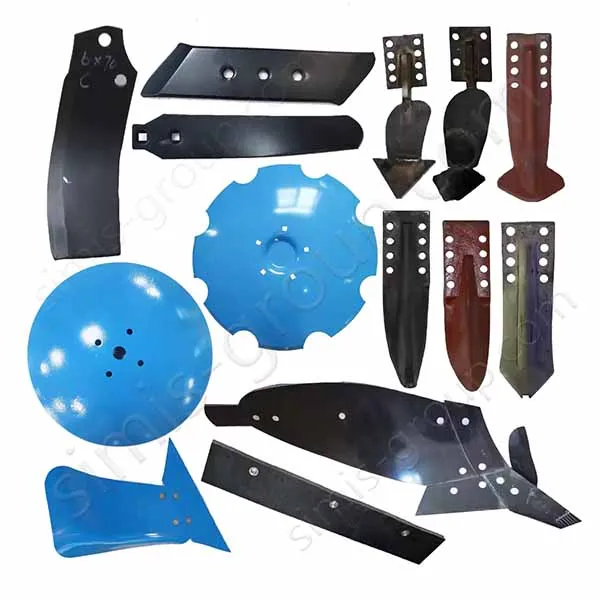
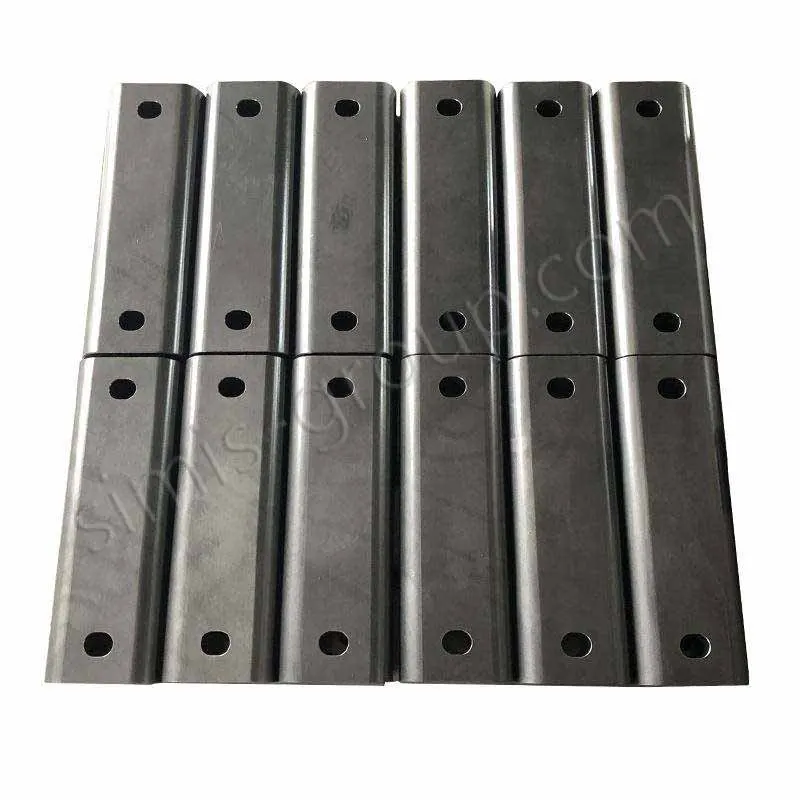
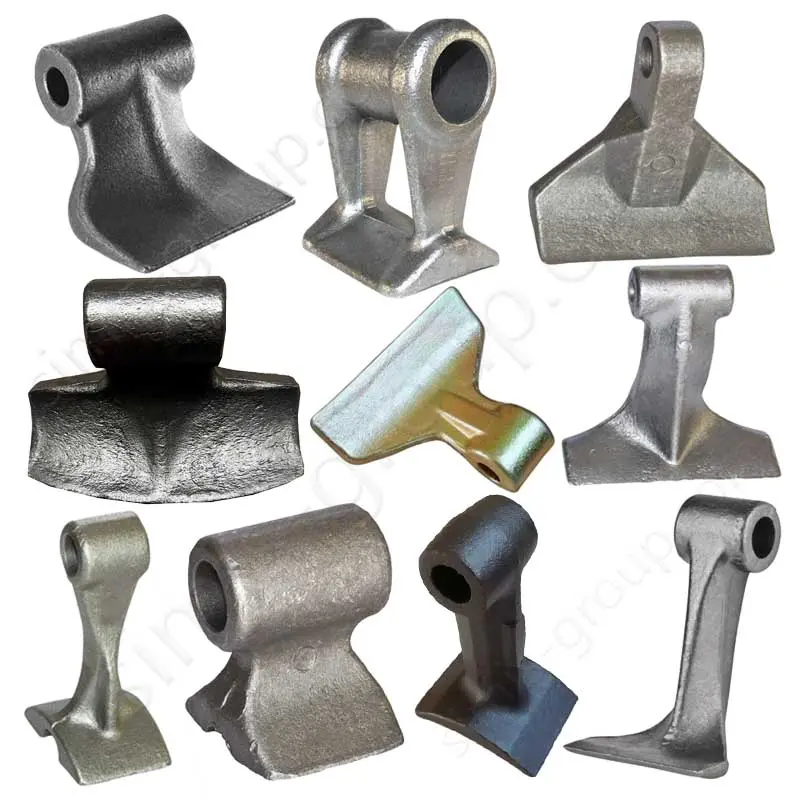
The photographs on this page include both wider winged sweeps and narrower soil-engaging components. For parts belonging to the complete moldboard structure rather than the replaceable cutting tool, see SIMIS custom plow body components.

Manufacturing Processes for Forged and Cast Plow Shovels
The shape of a soil-working blade has a strong influence on manufacturing process selection. A relatively thin, wide sweep may be made from formed steel plate, while a thicker point or complex mounting profile may favor forging or casting. Each route requires appropriate material selection, production controls and final dimensional verification.
Closed-die forging for selected steel points and shovels
Closed-die forging shapes heated steel in tooling designed for the component. It may be an effective option for selected tillage points and shovels with substantial sections or specially formed profiles. Forging parameters, die design and subsequent heat treatment influence the resulting mechanical properties. Forging does not automatically guarantee superior field wear life over every cast or formed alternative.
SIMIS can assess appropriate closed-die forging routes and related steel forging requirements based on material, tooling and quantity.
Sand casting for selected wear-resistant steel geometries
Steel sand casting may be considered for irregular, thicker or heavily contoured ground-engaging parts where the alloy and manufacturing route are appropriate. Mold design must consider feeding, shrinkage, section transitions and the required casting integrity. For wear applications, local casting quality and the specified heat-treated microstructure are important to the final component condition.
See our sand casting foundry and steel casting services for applicable casting-based manufacturing routes.
Cutting, pressing and forming steel plate
Some broad, relatively thin cultivator sweeps and plowshares can be produced by cutting a steel blank, creating the mounting holes and forming the required wings or curvature. The material must have suitable formability for the chosen sequence. If heat treatment follows forming, distortion and changes in critical hole positions should be considered. SIMIS can review compatible metal cutting and forming operations where appropriate.
| Production Route | Potential Application | Items to Review |
|---|---|---|
| Closed-Die Forging | Suitable formed steel shovels, thick points and repeat-production parts | Die geometry, steel grade, process sequence and heat treatment |
| Steel Sand Casting | Selected complex or thick-section cutting components | Casting soundness, feeding, microstructure and machining allowance |
| Plate Cutting and Forming | Wide, relatively thin sweeps and shares | Blank profile, bend geometry, formability and hole position |
| Secondary Machining | Mounting holes, locating features and selected attachment surfaces | Drawing datums, access, tool wear and final inspection |

Wear-Resistant Steel Selection for Agricultural Tillage Blades
The choice of steel for a plow shovel depends on abrasive wear, the possibility of striking stones, the blade thickness and the approved heat-treated condition. Soil containing hard particles can remove material from the cutting edge, while impact may cause chipping, bending or fracture. Material selection must balance these competing failure modes.
Carbon steel for specified tillage applications
Appropriate carbon steels may be used for plow blades where their mechanical properties and heat-treatment response satisfy the design. The carbon content, steel condition, geometry and operating duty should be reviewed together. The term carbon steel alone does not define adequate hardness, toughness or abrasion resistance.
Boron-alloyed and other heat-treatable steels
Selected boron-alloyed steels are used in agricultural wear-part manufacturing because their hardenability can support particular heat-treated property requirements. The actual performance depends on the steel grade, section thickness, quenching conditions and tempering. Higher hardness can improve resistance to some abrasive conditions but may increase the risk of edge chipping if toughness is insufficient.
Manganese-alloyed and specialty cast steels
Manganese content can be relevant to different alloy-steel systems. In particular, austenitic high-manganese steels are associated with work hardening under suitable deformation and impact conditions. They are not automatically the best choice for all low-impact abrasive soils. Buyers should specify the exact grade and its required condition rather than identifying a part only as manganese steel.
Ductile iron and other cast alternatives
Ductile iron may be considered for selected cast agricultural components when its specified properties and wear behavior suit the design. However, it should not be assumed equivalent to quenched and tempered wear-resistant steel for every thin cutting edge. Material substitution requires evaluation of the complete blade geometry and operating loads.
| Material Category | Possible Advantage | Selection Considerations |
|---|---|---|
| Carbon Steel | Range of forming and heat-treatment options | Grade, final hardness, toughness and soil conditions |
| Boron-Alloyed Steel | Hardenability for suitable heat-treated wear components | Quench response, tempering, section thickness and cracking risk |
| Specialty Alloy or Manganese Steel | Grade-specific wear and impact properties | Exact alloy system, processing condition and impact environment |
| Ductile Iron | Casting flexibility for compatible component designs | Grade, section properties and actual cutting-edge suitability |
A material recommendation should take account of the original approved component design. It is not appropriate to promise a fixed wear-life improvement solely because a proposed alloy has higher laboratory hardness.

Cutting Edge, Wing Angle and Soil-Working Geometry
The working profile is one of the most product-specific requirements for a plow shovel. Width, curvature, cutting-edge angle and tip shape can influence penetration, soil movement, residue interaction and draft force. These effects depend on the complete implement configuration and soil conditions, so manufacturing should preserve the customer's approved geometry rather than promise a universal improvement in field efficiency.
Tip angle and initial soil penetration
The nose or tip must match the intended soil-entry profile. Tip thickness, included angle and local curvature may influence how the tool enters the soil and how quickly the leading region wears. A pointed shovel for narrow penetration has different geometry from a broad sweep intended for shallow cultivation.
Sweep width and wing symmetry
Wide cultivator sweeps may have left and right wings with defined curvature or rake. Overall width, wing angle, formed height and symmetry should be controlled to the approved drawing. For asymmetric designs, the orientation and part number must be identified to prevent mixing left-hand and right-hand components.
Blade thickness, taper and edge finishing
Cutting edges may be manufactured with a specified taper, local bevel or formed profile. Edge thickness and allowed burr condition should be defined without unnecessarily weakening areas close to the mounting holes. Some designs use different section thicknesses across the blade, requiring process control during forging, casting or forming.

Mounting Holes, Square Openings and Replacement-Part Fit
Plow shovels are commonly attached to a shank, blade holder or plow body using mechanical fasteners. Correct fit is important because the attachment transfers operating forces and maintains the required working angle. A replacement tool should not be considered interchangeable merely because its overall width appears similar.
Round holes, square holes and bolt spacing
Some tillage blades use square openings for the specified fastener head or neck, while others use round or slotted holes. Hole diameter or across-flats dimension, center spacing, angular orientation and edge distance should follow the assembly drawing. Manufacturing may involve punching, forming, drilling or suitable secondary machining based on material condition and tolerance requirements.
Mounting-face position and blade pitch
The mounting region establishes how the blade sits against its holder and therefore affects the installed pitch and cutting direction. Formed curvature, mounting-face geometry and the distance between holes and cutting tip may be functionally important. The acceptable deviation should be determined from the equipment manufacturer's drawing.
Machining and final hole verification
Not every plow shovel requires CNC machining. In some production routes, adequately controlled punching and forming can produce acceptable mounting features. Where tighter tolerances or particular hole geometry are required, SIMIS can review appropriate machining and finishing operations. Final inspection should check the part in its required formed or heat-treated condition, not only at the blank stage.
Heat Treatment for Wear Resistance and Impact Toughness
Heat treatment can be a critical step for steel tillage parts when the specified grade requires a controlled final microstructure. Quenching and tempering may be applied to appropriate materials, while other alloy systems require different processing. The treatment should be developed around steel chemistry, section thickness and the required balance of hardness and toughness.
Hardness is only one part of wear performance
A harder cutting edge can resist some abrasive wear mechanisms, but excessive hardness without sufficient toughness may increase chipping or cracking risk in rocky soil. The drawing should identify the required hardness scale, measurement position and acceptable range. A specified HRC value should not be treated as a universal guarantee of field service life.
Distortion control after forming and heat treatment
Thin, asymmetric blades and wide sweeps may distort during heating and cooling. Tooling, support, thermal schedule and the manufacturing sequence should be reviewed. Final width, curvature, tip orientation and mounting-hole spacing may therefore require inspection after heat treatment rather than relying on pre-treatment measurements alone.
Localized treatments and hardfacing options
Certain designs may specify localized hardening or hardfacing in selected wear regions. These processes can affect profile dimensions, cracking risk and subsequent repairability. They are not automatically appropriate for every thin blade or highly loaded impact point. SIMIS can review project-defined heat treatment requirements according to the steel grade and drawing.

Surface Finishing and Protection During Storage
Agricultural wear tools may be stored or transported for extended periods before installation. Depending on the material and customer specification, finishing may include blasting, cleaning, painting, temporary rust prevention or a suitable industrial coating. Coatings should be compatible with the intended operation and any assembly requirements.
Because cutting edges contact abrasive soil, conventional surface coatings may wear away during use. A painted shovel should therefore not be described as having permanent corrosion or abrasion protection. The coating may serve primarily for handling, identification or storage protection. SIMIS can discuss applicable metal surface treatment requirements as part of an OEM order.
Quality Control for Custom Plow Shovels and Shares
A useful quality plan should verify material condition, cutting geometry and attachment fit. The necessary inspections depend on the blade design, production method and agreed acceptance criteria. For wear parts, hardness and dimensions may be important, but neither alone is proof of the service life achievable under actual field conditions.
| Inspection Item | Project-Specific Verification |
|---|---|
| Material Grade | Specified steel chemistry, grade and supporting material records |
| Hardness and Heat Treatment | Agreed hardness range, measurement locations and material condition |
| Working Profile | Width, length, tip angle, wing curvature, thickness and edge geometry |
| Mounting Features | Round or square hole dimensions, center spacing and mating fit |
| Forging or Casting Condition | Visual acceptance and project-specified defect inspection |
| Dimensional Stability | Final shape and alignment following forming and heat treatment |
| Finish and Identification | Burr removal, protective coating, markings and packaging condition |
| Documentation | First-article inspection, sampling results and batch traceability as agreed |
Profile and functional fit inspection
Templates, gauges, CMM measurement or suitable fixtures can be used to inspect the working profile and mounting region. For replacement parts, functional fit with an approved holder or representative gauge may be included in first-article inspection. The actual acceptance dimensions must follow the customer's drawing.
Mechanical and metallurgical checks
Hardness testing, chemical analysis or other material checks may be specified according to the selected steel and processing condition. Where impact properties or other mechanical requirements are important, the buyer should identify the appropriate test method and sampling plan. One hardness result cannot establish every mechanical property of the finished blade.
Non-destructive testing where required
Magnetic-particle inspection may be applicable for detecting certain surface and near-surface discontinuities in suitable ferromagnetic steels. Other NDT methods may be considered where justified by the design and material. No examination method should be described as proving complete freedom from internal defects or as guaranteeing that a ground-engaging tool cannot fracture in service.
SIMIS can review sampling methods and inspection documentation through its quality control capabilities. The final reporting scope should be agreed before manufacturing.

Applications and Field Conditions for Custom Tillage Tools
Cultivators and shallow tillage equipment
Wide sweeps and duckfoot-style shovels may be used on cultivators and other shallow tillage implements. Width, wing shape and mounting angle should be matched to the intended tool spacing and soil-working depth. The implement manufacturer determines the appropriate geometry for its machine and intended field conditions.
Moldboard plows and replaceable shares
A plowshare forms part of a moldboard plow's soil-cutting arrangement. Its outline, mounting interface and relationship to neighboring wear parts influence the installed configuration. OEM replacements should be manufactured to the approved assembly dimensions rather than relying on visual similarity to another manufacturer's share.
Subsoilers and heavy soil-breaking attachments
Narrow points and other deeper-working tools can experience different bending and impact conditions from wide shallow sweeps. Strongly loaded points may call for different material grades, cross-sections and attachment details. Selection should follow the implement's approved load cases and wear-part specification.
Variable soil and abrasive environments
Dry sandy soil, moist clay and stony ground can produce different wear and impact conditions. A blade that performs well in one environment may show different wear patterns in another. Any comparison of wear life, fuel use or replacement interval should therefore use a defined field-test method, comparable equipment settings and documented operating conditions.
Request a Quote for Custom Plow Shovels and Shares
SIMIS supports OEM production of custom steel plow shovels, plough shares, cultivator sweeps and other agricultural ground-engaging components according to customer-approved drawings. Our manufacturing review can cover material and process selection, forming or tooling, heat treatment, mounting features, protective finishing and an agreed inspection plan.
For a detailed RFQ, please provide: 2D drawings and available STEP or other 3D models; the shovel, point or share type; maximum length and width; blade thickness; cutting-edge and wing geometry; round or square mounting-hole dimensions; material grade and applicable standard; hardness and heat-treatment requirements; finish specifications; planned batch and annual quantities; and required inspection documents.
If the product is intended as a replacement part, please identify the mating holder and required attachment dimensions. Information about expected soil conditions, stone impact and operating duty can also support a more useful material and manufacturing review. Any proposed change to the steel grade, heat-treated condition or critical geometry should be approved by the customer's responsible engineer before production.
Send your custom plow shovel or share drawings and purchasing requirements to info@simis-group.com for a manufacturing feasibility review and quotation.