Custom Pulley & Sheave Manufacturer


Pulley & Sheave

Custom Pulleys and Sheaves: OEM Manufacturing FAQs
Can SIMIS manufacture custom pulleys and sheaves from our drawings?
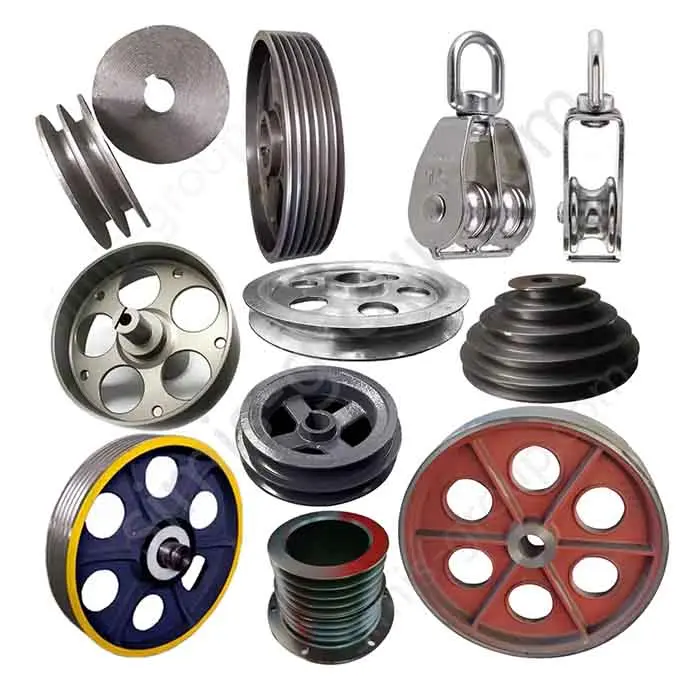
Yes. SIMIS supports OEM production of custom V-belt pulleys, multi-groove pulleys, industrial drive wheels and wire-rope sheaves according to customer drawings. Depending on the design, manufacturing may involve iron casting, steel casting, steel forging, aluminum casting, CNC turning, keyway machining and project-specific inspection. We review the groove specification, hub connection, operating speed, loading and production volume before recommending a manufacturing route.
What is the difference between a belt pulley and a wire-rope sheave?
A belt pulley transmits torque or guides a belt using a groove profile matched to the belt type. A wire-rope sheave guides a steel wire rope around a curved groove and must accommodate the rope diameter, construction, bending requirements and applied line tension. Their groove profiles, operating loads and acceptance criteria are not interchangeable. SIMIS can evaluate either type when suitable drawings and application information are provided.
Which materials are suitable for custom cast or forged pulleys?
Gray iron is commonly considered for industrial belt pulleys where its castability and damping characteristics are useful. Ductile iron, cast steel and forged steel may be specified for other load conditions. Aluminum alloys can reduce mass for suitable designs. Material selection depends on groove wear, bending and radial loads, rotational speed, environmental exposure and the applicable engineering specification.
Can SIMIS machine the grooves, hub bore and keyway to drawing requirements?
SIMIS supports CNC turning and other machining operations for groove profiles, shaft bores, bearing seats, keyways, retaining features and mounting holes. Critical requirements can include groove angle or radius, pitch diameter, groove spacing, bore fit, runout and face alignment. Actual tolerances are determined by the customer drawing and the intended belt, rope or shaft assembly.
Do all pulleys need dynamic balancing and non-destructive testing?
No. Balancing and inspection requirements depend on rotating speed, wheel mass, operating conditions and application risk. Some low-speed components may need only dimensional and runout checks, while other rotating pulleys require a specified residual-unbalance limit. Lifting sheaves may require additional material and integrity inspection. The required test method, acceptance criteria and documentation should be established before production.
OEM Cast and Forged Pulleys for Industrial Power Transmission
Pulleys and sheaves are grooved rotating components used in mechanical power transmission, belt guidance and cable or wire-rope systems. Their geometry determines how a belt or rope contacts the wheel, while the material and hub arrangement influence the ability to withstand the specified operating conditions.
Custom designs may include single-groove V-belt pulleys, multiple-groove drive pulleys, wide industrial pulleys, steel wire-rope sheaves and specialized tensioning wheels. Important drawing features include outside diameter, pitch or datum diameter, groove profile, face width, hub dimensions and shaft or bearing connections.
SIMIS manufactures drawing-based metal components instead of requiring customers to select from a fixed standard-pulley catalog. The proposed route is evaluated according to the component's geometry, material specification, production quantity and inspection requirements.


V-Belt Pulleys vs. Wire-Rope Sheaves: Understanding the Groove
A pulley should be specified using the belt or rope that will actually run in its groove. Similar-looking round wheels can have very different contact geometry. Selecting the wrong groove can lead to poor engagement, concentrated contact pressure, accelerated wear or loss of the intended operating performance.
| Component Type | Groove or Contact Geometry | Key Application Data |
|---|---|---|
| Single or Multi-Groove V-Belt Pulley | V-shaped groove matched to the specified belt section | Belt profile, pitch or datum diameter, groove spacing and transmitted power |
| Synchronous Belt Pulley | Toothed profile designed for a matching belt system | Tooth profile, pitch, belt width and drive requirements |
| Wire-Rope Sheave | Rounded rope-supporting groove with a specified radius and opening | Rope diameter, construction, sheave pitch diameter and line tension |
| Flat-Belt Pulley | Flat or specified crowned running surface | Belt width, tracking arrangement and contact diameter |
For classical and narrow V-belt pulleys, an applicable groove standard such as ISO 4183 may be used when required by the project. For a wire-rope sheave, the drawing should follow the relevant rope manufacturer's recommendations and equipment design requirements. A V-shaped belt groove must not be substituted for a rounded wire-rope groove merely because both components are described as pulleys.

Manufacturing Processes: Casting, Forging and CNC Machining
The manufacturing method should be chosen for the required material properties, wheel geometry, production quantity and operating loads. Neither casting nor forging is universally superior. The design of the rim, spokes or web, hub and groove determines which processes are practical.
Sand casting for large cast iron pulleys
Sand casting is a common option for large iron pulleys with thick hubs, integral spokes, wide faces or multiple belt grooves. Pattern design must consider rim-to-spoke transitions, gating, feeding, shrinkage and sufficient stock for final turning. SIMIS can evaluate these components through its sand casting foundry.
Shell mold casting for repeat-production wheels
For suitable smaller and medium-sized iron pulleys, shell mold casting may provide useful repeatability and detailed mold definition. Critical groove dimensions and shaft interfaces may still require machining. Tooling investment, part size and batch quantity influence the manufacturing decision.
Steel forging for selected heavily loaded components
Forged steel blanks may be specified for sheaves and pulleys subject to demanding mechanical loading or particular material requirements. Closed-die forging can suit repeat-production shapes where tooling and geometry are appropriate, while other forging routes may be considered for larger blanks. Our closed-die forging capabilities provide one possible route. Final suitability still depends on the grade, forging condition, subsequent heat treatment and verified design.
Aluminum casting for weight-sensitive applications
For selected smaller and lighter designs, aluminum pulleys may be produced using gravity permanent mold casting or pressure die casting. The proposed process should account for alloy properties, tooling cost, hub strength, wear conditions and possible porosity. Aluminum is not an automatic replacement for a highly loaded steel rope sheave.
| Process | Potential Fit | Points to Evaluate |
|---|---|---|
| Sand Casting | Large gray or ductile iron belt pulleys | Rim and hub soundness, weight and machining stock |
| Shell Mold Casting | Suitable repeat-production iron wheels | Tooling, casting repeatability and process size limits |
| Steel Forging | Selected loaded pulley and sheave blanks | Grade, forging geometry, heat treatment and validation |
| Aluminum Casting | Weight-sensitive designs and suitable production volumes | Local strength, porosity and groove wear |
| CNC Machining | Groove finishing, shaft bores, keyways and bearing interfaces | Datum alignment, profile accuracy and runout |

Material Selection for Custom Pulleys and Wire-Rope Sheaves
Material choice affects component mass, stiffness, wear behavior, corrosion resistance and the available manufacturing methods. The correct grade must be established from the load case and mating belt or rope arrangement, rather than chosen solely by nominal tensile strength.
| Material | Potential Advantages | Important Limitations |
|---|---|---|
| Gray Cast Iron | Castability, machinability and useful vibration damping | Limited ductility; design must consider hub, rim and spoke loading |
| Ductile Iron | Available grades with greater elongation and different strength characteristics | Nodularity, casting section and fatigue conditions require review |
| Cast or Forged Steel | Broad material and heat-treatment choices for engineered load cases | Process quality, weight, machining and heat-treatment requirements |
| Aluminum Alloy | Reduced component mass for compatible pulley designs | Groove wear, hub loading and thermal expansion |
| Stainless Steel | Material options for specified corrosive environments | Grade-specific strength, cost, machinability and wear behavior |
Gray iron is often considered for industrial multi-groove V-belt pulleys, while other grades may be selected for different loads or operating environments. More information about gray iron material behavior is available on our custom gray iron parts page. Any substitution from forged steel to cast iron, or from steel to aluminum, requires appropriate engineering approval.

Precision Groove Geometry: V-Belts and Steel Wire Ropes
V-belt groove angle, width and spacing
A V-belt pulley groove is defined by the selected belt section and its corresponding pulley specification. Important dimensions can include groove angle, datum width, datum diameter, groove pitch and overall face width. For conventional V-belt drives, belt contact is intended along the groove flanks rather than by bottoming out. A groove must therefore match the actual belt system instead of being machined to a generic V shape.
Wire-rope groove radius and opening angle
A wire-rope sheave requires a rounded contact groove that supports the rope without excessive pinching or localized pressure. The specified radius, depth and opening angle depend on rope diameter, construction and the equipment standard. Groove wear and rope diameter variation can affect service performance. A replacement sheave must be reviewed against the rope actually installed, not merely copied from an existing worn groove.
Sheave diameter and rope bending ratio
For wire-rope systems, the ratio of sheave pitch diameter to nominal rope diameter, commonly expressed as D/d, is an important design parameter. The acceptable ratio depends on rope construction, equipment type and the applicable manufacturer or regulatory requirements. SIMIS can manufacture to the approved dimensions, but the required D/d ratio and its effect on rope service life must be established by the equipment designer.
Profile inspection and groove surface finish
Groove gauges, profile measurement, diameter checks and appropriate surface inspection can be used according to the drawing. Burrs, damage, machining marks and irregular groove geometry may influence belt or rope contact. The allowable surface roughness and inspection frequency should be specified for the actual application.

CNC Machining: Hub Bores, Keyways, Bearings and Runout
After casting or forging, the groove and functional connection features may require precision turning, milling, boring or other machining operations. SIMIS offers CNC machining for customer-defined pulley geometry and assembly interfaces.
Shaft bores, keyways and locking features
A drive pulley may connect to a shaft through a keyed bore, taper-lock bushing, splined interface or other specified system. The bore diameter, keyway dimensions, shoulder position and locking features must match the selected assembly. The appropriate fit depends on transmitted torque, operating temperature, shaft material and mounting procedure.
Bearing pockets and idler sheave arrangements
Unlike a keyed drive pulley, an idler or freely rotating sheave may incorporate rolling bearings or a bushing. Bearing pockets require attention to diameter, shoulder geometry, retention, lubrication and sealing. SIMIS also manufactures related custom bearing seats and housings for industrial machinery.
Radial runout, face runout and datum selection
The relationship between the finished bore and groove diameter is important for true running. Depending on the design, radial runout, face runout, groove-to-bore alignment and hub-face perpendicularity may be controlled. Inspection should use the functional datum scheme on the customer's drawing. A universal runout tolerance cannot be assumed for every diameter or operating speed.

Static Balance, Dynamic Balance and Rotational Performance
An uneven distribution of mass around the rotation axis can generate additional forces during operation. Whether balancing is necessary, and which method is appropriate, depends on pulley speed, mass, diameter, bearing arrangement and the sensitivity of the complete machine.
Static balancing for applicable wheel designs
A static balance assessment may be relevant for some wheel geometries and operating conditions. It addresses the mass distribution relative to the rotation axis but does not automatically characterize all dynamic unbalance effects in a wider or more complex rotor.
Dynamic balancing to a project-defined acceptance limit
For rotating assemblies requiring dynamic balancing, the customer should specify the relevant standard, operating speed, balancing configuration and acceptable residual unbalance. ISO 21940-11 is one relevant standard for rotors exhibiting rigid behavior. A balance quality grade such as G6.3 must not be imposed on all pulleys regardless of service conditions. The required balancing operation and reporting must be agreed for the project.
Balancing is not the same as dimensional accuracy
A component can have acceptable geometric runout and still exhibit mass unbalance, or it can be balanced while having an unsuitable groove profile. Both characteristics must be assessed separately where required. A balanced pulley also cannot independently guarantee low vibration, reduced noise or a particular bearing life for the full drive system.

Heat Treatment, Groove Wear and Protective Finishing
Some steel pulleys or sheaves may require heat treatment to achieve a specified hardness, strength or wear-related property. The appropriate process depends on material chemistry, part dimensions and the required final condition. Heat treatment may also influence distortion and the machining sequence.
Where a steel sheave drawing specifies a hardened groove surface, the process may involve an approved localized hardening method followed by hardness and dimensional inspection. However, hardening is not universally necessary or suitable. Excessive hardness, an unsuitable heat-affected zone or an incompatible rope contact surface may create other performance problems. SIMIS can discuss project-defined heat treatment options.
Industrial pulleys may also receive blasting, painting or other protective finishes. Coatings on belt-running or rope-contact surfaces should be reviewed for friction, wear and assembly effects. Bore fits and bearing seats may need masking. See our surface treatment services for relevant finishing possibilities.
Quality Inspection for Custom Cast and Forged Pulleys
A suitable inspection plan combines material verification, geometric measurement and any application-specific testing. Requirements for a moderate-speed industrial belt pulley may be very different from those for a sheave incorporated into a safety-related lifting system.
| Inspection Item | Project-Specific Verification |
|---|---|
| Material Grade | Chemical composition, specified mechanical properties and applicable material reports |
| Groove Profile | V-groove angle and spacing, or rope-groove radius and depth, as applicable |
| Hub and Bearing Interfaces | Bore diameter, keyway, bearing pocket, shoulders and locating datums |
| Running Geometry | Radial and face runout, groove position and other specified GD&T features |
| Balance | Static or dynamic balancing where required, using agreed acceptance criteria |
| Casting or Forging Integrity | Visual inspection and suitable NDT in specified locations |
| Hardness and Finish | Specified groove hardness, surface condition and protective coating |
| Documentation | First-article reports, batch records and traceability where agreed |
Magnetic-particle, ultrasonic, penetrant or other non-destructive examination methods may be selected according to the material and required defect detection. Their coverage and acceptance rules must be stated clearly. No NDT method should be described as guaranteeing a completely defect-free casting or forging.
For lifting and hoisting applications, material certificates and individual sheave inspection cannot independently establish the rated capacity of the complete crane, hook block or lifting assembly. That responsibility requires the applicable system design, component requirements and validation. SIMIS can review the specified manufacturing documentation through its quality control process.
Applications of Custom Industrial Pulleys and Sheaves
Agricultural machinery and industrial belt drives
Agricultural machines, compressors, fans, pumps and other belt-driven equipment may use single or multiple V-groove pulleys. The selection depends on the belt system, shaft connection, transmitted power, speed and operating environment. Casting and CNC finishing can be combined to produce drawing-specific wheel designs.
Conveyors, mining equipment and heavy machinery
Industrial drive systems may require large-diameter or multi-groove wheels with substantial hubs and controlled running geometry. Abrasive environments, heavy-duty cycles and installation constraints should be considered when selecting materials and finishes. Operating limits must be defined by the machinery manufacturer.
Cranes, hoists and cable-guidance systems
Wire-rope sheaves can be used in cranes, winches, hoists and other rope-guidance systems. These components require attention to rope groove geometry, sheave diameter, bearing arrangement and the approved loading conditions. Their material and inspection requirements may be more demanding than those of ordinary belt pulleys. An OEM drawing and applicable equipment specification are essential.
Special-purpose transmission and tensioning equipment
Textile equipment, machinery test rigs and other specialized systems may use custom pulley widths, hub arrangements or guiding profiles. Manufacturing feasibility should be reviewed against the selected belt or cable, the available installation space and the machine's operating requirements.

Request a Quote for Custom Pulleys and Sheaves
SIMIS supports OEM manufacturing of cast and forged pulleys and sheaves according to approved customer drawings. The manufacturing review may cover material selection, casting or forging feasibility, groove machining, heat treatment, finishing and project-specific inspection.
For a detailed quotation, please provide: 2D drawings and STEP or other available 3D models; pulley or sheave type; belt section or wire-rope construction and diameter; outside and pitch or datum diameters; number of grooves and required profile; face width; bore, keyway or bearing specification; material grade; operating speed; applicable loads or transmitted power; required balancing and inspection criteria; and anticipated batch and annual quantities.
For lifting-related sheaves, include the applicable equipment standard, load cases, approved component design, required NDT and documentation. For high-speed pulleys, specify the relevant balance requirements and assembly conditions. Any material or groove-profile substitution should be approved by the customer's responsible engineer before production.
Send your custom pulley or sheave drawings and purchasing requirements to info@simis-group.com for a manufacturing feasibility review and quotation.