Custom Ball Mill Liner Manufacturer


Ball Mill Liner

Custom Ball Mill Liner Manufacturing FAQs
Can SIMIS manufacture replacement ball mill liners from our drawings or existing samples?
Yes. SIMIS supports drawing-based OEM production of metal ball mill liners, including lifter liners, corrugated liners and other specified casting geometries. We review 2D drawings, 3D models, material requirements, quantities and the liner's installation position before evaluating a casting route. If an existing worn liner is used as a reference, the OEM should confirm its original profile and mounting dimensions; wear may have changed the sample's geometry.
Which material is better for ball mill liners: manganese steel, high-chrome iron or alloy steel?
There is no universal best alloy. Austenitic high manganese cast steel is often considered for substantial repeated impact, which can encourage work hardening. High-chromium white cast iron may suit abrasion-dominant service when impact and fracture risks are compatible with the grade. Alloy cast steels offer further options for balancing toughness, wear resistance and section size. Ore characteristics, ball size, mill operating conditions and the customer's approved material specification should determine the selection.
Can you reproduce a specific lifter height, corrugated profile or segmented liner design?
Custom profiles can be evaluated against supplied drawings or CAD models. Lifter height, face angle, section thickness, curvature, segment width and bolt locations influence both manufacturing feasibility and mill installation. The liner profile is usually defined or approved by the OEM because it also affects the grinding-media trajectory. Manufacturing a specified shape does not, by itself, verify a particular mill throughput or energy-consumption result.
Do all liner bolt holes and mounting faces require CNC machining?
Not necessarily. Some noncritical features can be produced close to their final dimensions by casting; specified bolt holes, counterbores, locating features or contact faces may require CNC machining when the drawing calls for tighter fit or surface requirements. The appropriate machining allowance and inspection datum should be agreed before tooling. Hole alignment must be assessed together with the shell layout and the complete liner assembly.
What information should we send for a custom ball mill liner quotation?
Provide a dimensioned drawing or 3D model, required material grade, liner type and quantity, mill diameter or relevant shell radius, mounting-bolt pattern, wear profile and any machining or inspection requirements. Ore or feed type, wet/dry grinding conditions, grinding-ball size and current wear or failure observations are also useful for reviewing material suitability. Please state whether your order is for individual replacement segments or a coordinated liner set.
OEM Cast Ball Mill Liners Made to Your Specifications
Ball mill liners protect the mill shell and provide a working surface that interacts with grinding media and feed material. A liner must fit its assigned position and withstand the operating combination of impact, abrasion and, in some installations, corrosion. SIMIS supplies custom metal castings manufactured from customer drawings rather than off-the-shelf replacement liners intended to fit every mill model.
Typical OEM requirements involve a replacement wear plate, lifting liner, corrugated liner or a specified segment within a larger mill lining system. The engineering review begins with the geometry of that part: its radial curvature, thickness transitions, lifter shape, mounting features and expected wear exposure. Material and casting method are then considered together with the required production quantity.
SIMIS also manufactures other engineered mining and mineral-processing components that need project-specific alloy and dimensional requirements.

Ball Mill Liner Types and Critical Design Features
The geometry of a ball mill liner varies with the grinding duty and the OEM's liner arrangement. The following types describe common functional distinctions, not interchangeable standard products.
| Liner type | Function and geometry | Drawing details to confirm |
|---|---|---|
| Lifter liner / lifting bar | Raised profile helps influence the movement of the grinding charge. | Lifter height, face angle, local thickness, fastening arrangement, segment orientation. |
| Corrugated liner | Ribbed or wave-like wearing surface distributed across the shell. | Corrugation pitch, rib height, cast section thickness and matching adjacent segments. |
| Flat / wear plate liner | Provides a protective wear surface with relatively limited elevation. | Overall thickness, shell curvature, wear allowance and fixing-hole positions. |
| Special segmented liner | Custom profile designed for a specified mill zone or replacement program. | Part numbers, segment identification, rotation direction, mill location and installation interfaces. |
Shell Radius, Liner Segmentation and Bolt-Hole Fit
Even a correctly cast liner can be difficult to assemble if the drawing does not define its contact geometry. The mill shell radius, liner chord length, bolt spacing, edge clearances and neighboring segment arrangement all influence fit. Counterbore depth and fastener seating features should be defined from the OEM's approved drawing, not estimated from a worn sample.
Lifter Profile, Wear Allowance and Section Transitions
Lifter height, ramp angle and section thickness affect the geometry being cast and the liner's usable wearing volume. Smooth section transitions may help reduce manufacturing difficulty and local stress concentration, subject to the design. Where a custom replacement profile is required, the OEM should provide the intended unworn profile and tolerance references. SIMIS can review manufacturability; the mill designer remains responsible for validating grinding performance.
Choosing Materials for Cast Ball Mill Liners
Material choice should reflect the balance of impact energy, abrasive wear, feed hardness, mill speed, grinding-media size and operating environment. Selecting the hardest alloy is not always the right solution: resistance to breakage and the ability to accommodate impact may matter as much as surface hardness.
| Material family | Useful characteristics | Important selection considerations |
|---|---|---|
| High manganese cast steel | Austenitic grades can offer impact toughness and may work-harden under sufficiently severe repeated contact. | Check actual impact intensity, section size, specified manganese grade and the approved property requirements. |
| High-chromium white cast iron | Carbide-rich structures can offer good resistance in suitable abrasion-dominant grinding duties. | Evaluate impact severity, fracture risk, carbide/matrix requirements and hardness acceptance criteria. |
| Alloy cast steel | Grades may be selected for an application-specific combination of strength, toughness and wear behavior. | Confirm chemical composition, mechanical properties, section thickness and required manufacturing route. |
If requested by the buyer, ASTM A128/A128M may be a reference for austenitic manganese steel castings, while ASTM A532/A532M may be relevant to abrasion-resistant white iron castings. The exact grade, edition, supplementary requirements and acceptance tests must be identified in the purchase specification. A material designation is not evidence of a finished mill liner's service life.
The final microstructure and properties also depend on the specified processing route and production controls. Where the drawing requires hardness measurements, chemical analysis, microstructural examination or mechanical test records, these should be included in the agreed inspection plan.
Casting and Machining Methods for Custom Mill Liners
Sand Casting for Large or Thick-Section Liners
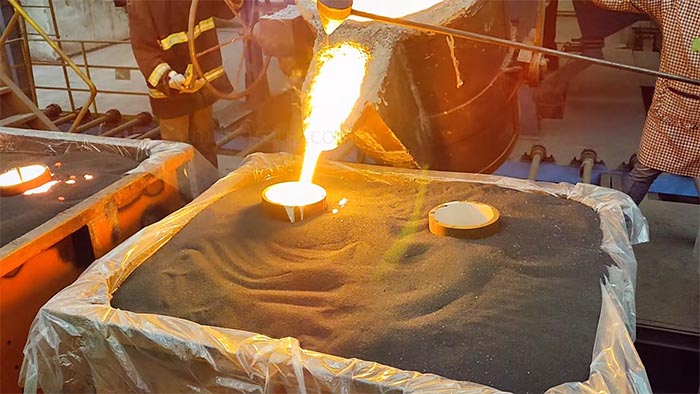
Sand casting is commonly evaluated for substantial wear-resistant iron and steel components. It can accommodate large segments and lifting profiles, subject to mold design and alloy requirements. Key planning points include feeding and solidification, local wall thickness, shrinkage allowances, pattern dimensions and any machined interfaces. Casting soundness cannot be assumed from the process name alone; the required acceptance level must be specified.
Lost Foam Casting for Suitable Complex Profiles
Lost foam casting can be considered for certain liner geometries where the expendable-pattern approach is technically and economically appropriate. It is not automatically the best choice for every high-alloy or thick-section liner. Alloy behavior, pattern design, defect risk, dimensional requirements and batch size must be reviewed before selecting this option.
CNC Machining for Mounting and Locating Features
Machining may be required for critical bolt holes, counterbores, locating shoulders and contact surfaces when specified tolerances cannot be achieved economically in the casting alone. The machining plan should use agreed datums, preserve the necessary wear thickness and account for how the liner sits against the mill shell. For parts supplied as raw castings, the customer may instead specify machining stock for finishing elsewhere.
Where the project involves custom steel wear castings, our steel casting capabilities provide further background on drawing-based casting services.
Dimensional Inspection and Material Verification
Inspection should match the function and risk of each custom liner, rather than repeat the same test for every order. The OEM should specify the critical-to-fit and critical-to-performance characteristics on the drawing and in the procurement documents.
Profile and dimensional checks: overall size, shell-contact radius, lifter height, segment curvature, thickness and any critical machined dimensions.
Mounting-hole layout: hole diameter, position, counterbore geometry and spacing relative to the selected datums.
Material confirmation: specified chemical composition and agreed hardness or mechanical-property testing.
Casting acceptance: surface condition, relevant defects and any project-specific radiographic, ultrasonic, dye-penetrant or magnetic-particle examination, when suitable for the alloy and requested.
Batch identification: marking and documentation required to associate castings with their material specification and liner positions.
Different alloys have different practical inspection limitations, especially in thick or carbide-rich sections. The examination method, scope and acceptance criteria should therefore be selected with the material and casting geometry in mind. Material certificates or dimensional inspection records do not independently demonstrate a guaranteed liner lifespan or complete mill efficiency.
Applications in Mining, Cement and Bulk-Material Grinding
Custom cast mill liners may be specified for ore-processing ball mills, cement grinding systems, coal grinding equipment and other industrial comminution applications. The operating environment changes the relative importance of abrasion, impact and corrosion: a high-impact coarse-grinding position may require a different alloy and geometry than a fine-grinding position exposed to persistent sliding abrasion.
Operating history can help the customer refine an RFQ. Uneven liner wear, broken lifters, enlarged mounting holes or repeated problems at specific shell positions should be documented alongside drawings. This information may identify where the OEM needs to review material properties, profile geometry, fastener configuration or maintenance practices.
For other wear-intensive mining components, see our custom chocky wear bars and blocks and crusher hammer head castings. Their wear mechanisms differ from ball mill liners, so their material selections are not automatically interchangeable.
Request a Quote for Custom Ball Mill Liners
SIMIS supports OEM buyers looking for custom cast ball mill liners and related mining wear components made to approved drawings. Our manufacturing review can address feasible casting methods, alloy specification, machining scope, inspection documentation and production quantity. Performance targets for the complete grinding circuit should be separately assessed and approved by the equipment owner or designer.
Drawings and identification: 2D/3D files, liner type, segment position, part number and current or desired profile.
Installation geometry: mill shell radius/diameter, liner thickness, bolt pattern, counterbores and adjacent segment interfaces.
Operating conditions: wet or dry grinding, feed or ore characteristics, media size, grinding stage and known wear/failure mode.
Procurement requirements: requested material grade, annual/order quantity, drawing tolerances, inspection records and delivery destination.

Send your project drawings to info@simis-group.com or contact SIMIS for an OEM quotation. We can review the part specifications and discuss a suitable manufacturing proposal before tooling and production.