What Are Gates and Risers in Casting?
In casting engineering, gates and risers are two core auxiliary structures that directly determine the internal quality, dimensional accuracy, and mechanical properties of castings. As an engineer with years of practical experience in casting process design, I will elaborate on the definition, structural design, functional principles, and application details of gates and risers, clarify common misunderstandings, analyze their impact on casting defects, and combine SIMIS Group’s casting process practice to provide professional technical guidance for engineering and procurement personnel.
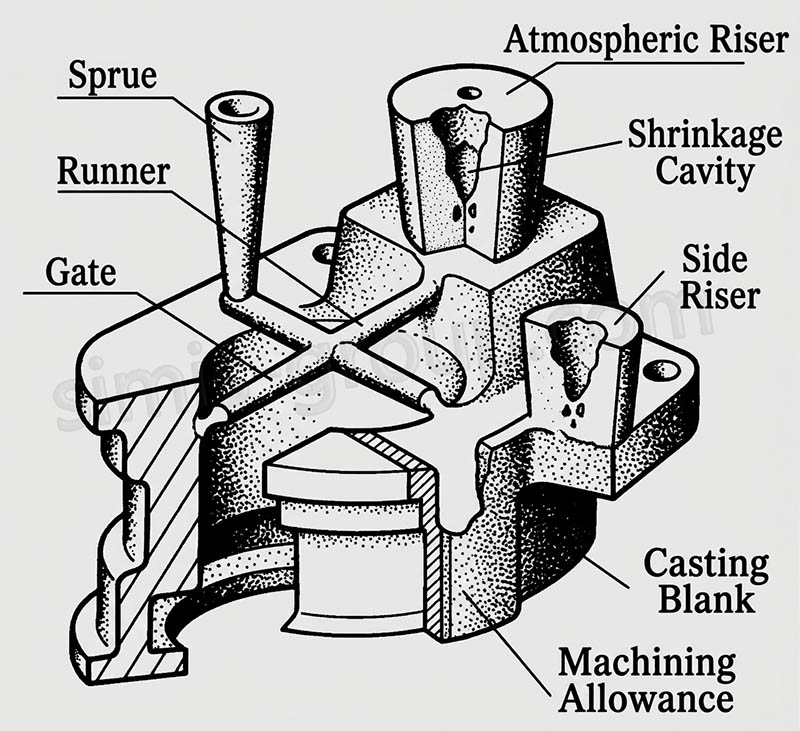
What Is a Gate in Casting?
In casting process design, a gate (referred to as ingate in engineering) is the key channel that connects the sprue or runner to the mold cavity, responsible for guiding molten metal to fill the cavity smoothly, stably, and efficiently. From an engineering perspective, the gate is not just a simple "inlet" but a core component that controls the filling dynamics and affects the final quality of castings, and its design needs to be matched with the alloy type, casting structure, and molding process.
The core functional principles of the gate are as follows:
First, it controls the filling speed and flow direction of molten metal. For different alloys (such as carbon steel, ductile iron, and aluminum alloy), the optimal filling speed varies—for example, the filling speed of low-carbon steel castings should be controlled at 0.5-1.2 m/s to avoid turbulence, while aluminum alloy castings can be appropriately increased to 1.0-1.5 m/s due to their good fluidity.
Second, it reduces molten metal turbulence, splashing, and oxidation. By optimizing the cross-sectional shape and size of the gate, the kinetic energy of the molten metal is converted into stable laminar flow, reducing the entrainment of slag and gas.
Third, it achieves uniform distribution of molten metal. For castings with complex structures or uneven wall thickness, multi-point gating can be adopted to ensure that each part of the cavity is filled synchronously, avoiding defects such as misrun caused by uneven cooling.
Common types of gates in engineering practice and their application scenarios:
·Top gating:
The gate is set at the highest point of the mold cavity. The molten metal flows from top to bottom, with the advantages of simple structure and full filling, but it is easy to cause splashing and oxidation. It is suitable for small and medium-sized castings with simple structure and low quality requirements, such as gray iron brackets.
·Bottom gating:
The gate is set at the bottom of the mold cavity. The molten metal fills the cavity from bottom to top, with stable flow and less turbulence, which can effectively prevent slag inclusions and gas entrapment. It is widely used in large castings, thick-walled castings, and alloy castings with high quality requirements, such as carbon steel machine tool beds.
·Side gating:
The gate is set on the side of the mold cavity, parallel to the parting surface. It has the advantages of uniform filling and easy removal of gating system, and is suitable for plate, shell, and other castings, such as aluminum alloy automotive parts.
·Press gating and fan gating:
Press gating is designed with a narrow cross-section to increase the filling speed and generate pressure, suitable for thin-walled castings; fan gating expands the flow channel into a fan shape, which can reduce the impact of molten metal on the mold cavity and is suitable for large-area thin-walled castings, such as engine cylinder heads.
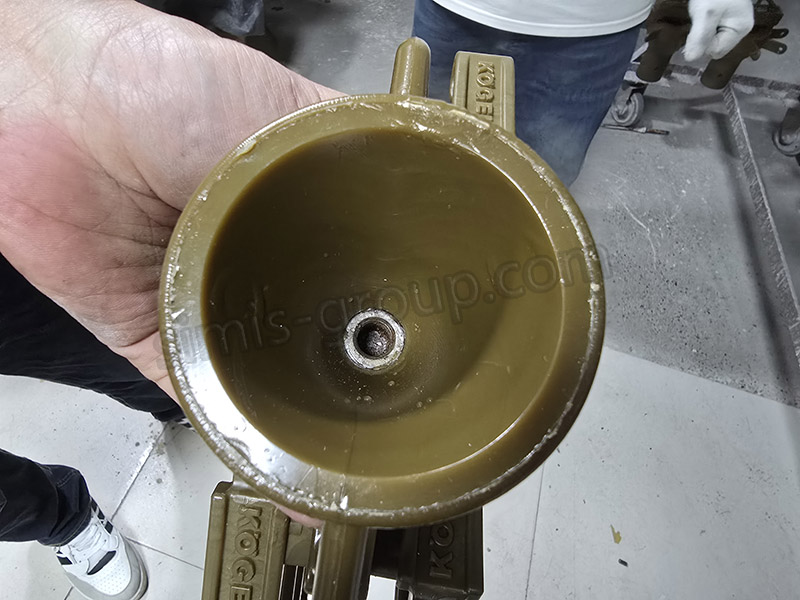
What Is a Riser in Casting?
A riser (referred to as feeder in engineering) is a reservoir structure designed on the casting or mold, which stores a certain amount of molten metal. Its core function is to compensate for the volumetric shrinkage of molten metal during the solidification process, so as to avoid internal defects such as shrinkage cavities and porosity in the casting. In engineering practice, the design of the riser must follow the principle of directional solidification—that is, the riser solidifies after the casting, ensuring that the molten metal in the riser can continuously feed the casting during the solidification process.
From the perspective of material properties, the need for risers is closely related to the shrinkage rate of the alloy. For example, the volumetric shrinkage rate of carbon steel is 10%-12%, ductile iron is 8%-10%, and aluminum alloy is 6%-8%, all of which require risers to compensate for shrinkage; while the volumetric shrinkage rate of gray iron is only 2%-4%, and risers may not be needed for small and thin-walled gray iron castings. The core design parameters of the riser include volume, height, cross-sectional shape, and position. The volume of the riser must be sufficient to compensate for the total shrinkage of the casting, and the height must ensure that the molten metal in the riser has a certain static pressure to avoid shrinkage due to insufficient feeding pressure.
Common types of risers and their engineering applications:
·Top riser:
Set at the highest point of the casting, with good feeding effect, suitable for thick-walled parts and castings with complex internal structures, such as heavy-duty gear blanks.
·Side riser:
Set on the side of the casting, convenient for mold design and casting cleaning, suitable for medium-thick-walled castings, such as connecting rods.
·Blind riser:
Set inside the mold, not connected to the outside atmosphere, with good thermal insulation effect, suitable for castings with high requirements on surface quality, such as precision investment castings.
·Open riser:
Connected to the outside atmosphere, with simple structure and easy observation of filling status, suitable for large castings with low surface quality requirements, such as steel ingots.
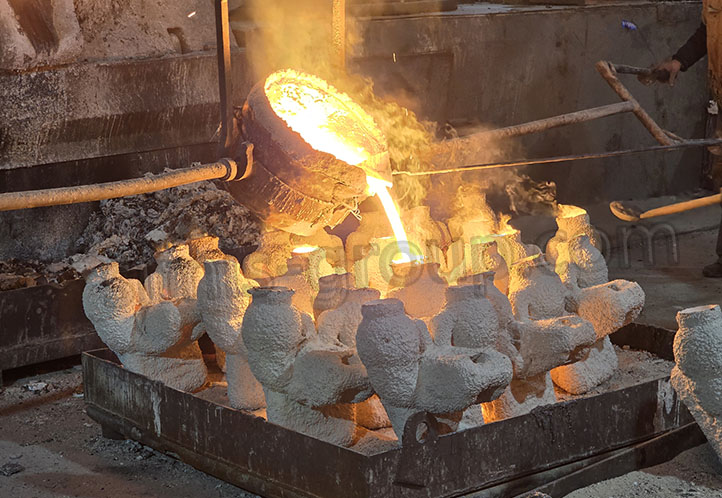
Does a Gate in Casting Always Require a Riser?
In engineering practice, there is no absolute correspondence between gates and risers—gates are necessary for most casting processes (used to fill the mold cavity), while risers are not required in all cases. The core judgment criteria for whether a riser is needed depend on three key factors: alloy shrinkage rate, casting wall thickness and structure, and casting process type.
First, from the perspective of alloy shrinkage rate:
Alloys with high shrinkage rate (such as carbon steel, ductile iron, aluminum alloy, copper alloy) must be equipped with risers when casting thick-walled parts, because their volumetric shrinkage during solidification is large, and the molten metal in the cavity cannot self-compensate, leading to shrinkage defects; alloys with low shrinkage rate (such as gray iron, malleable iron) can be free of risers when casting small, thin-walled parts, because their shrinkage can be compensated by the graphitization expansion during the solidification process.
Second, from the perspective of casting wall thickness and structure:
For castings with uniform wall thickness and small thickness (generally less than 15mm), the molten metal solidifies uniformly, and the shrinkage can be compensated by the adjacent molten metal, so risers are not needed; for castings with uneven wall thickness, especially those with thick-walled parts (more than 20mm), the thick-walled parts solidify slowly, and the shrinkage is large, so risers must be set at the thick-walled parts to ensure feeding.
Third, from the perspective of casting process type:
In high-pressure die casting, low-pressure die casting, and other processes, the molten metal is filled into the mold cavity under high pressure, and the pressure can continuously compensate for the shrinkage of the molten metal during solidification, so risers are generally not used; in sand casting, investment casting, and other processes, the filling pressure is low, and risers are usually required for castings with high quality requirements.
Typical engineering examples:
1. Small gray iron bolts (wall thickness 8-10mm) are cast by sand casting, only gates are used, no risers are needed, and the shrinkage is compensated by graphitization expansion;
2. Carbon steel engine cylinder blocks (maximum wall thickness 30mm) are cast by sand casting, side gates are used for filling, and top risers are set at the thickest part of the cylinder block to compensate for shrinkage;
3. Aluminum alloy automotive wheels are cast by low-pressure die casting, bottom gates are used for filling, and no risers are needed, relying on low pressure to compensate for shrinkage.
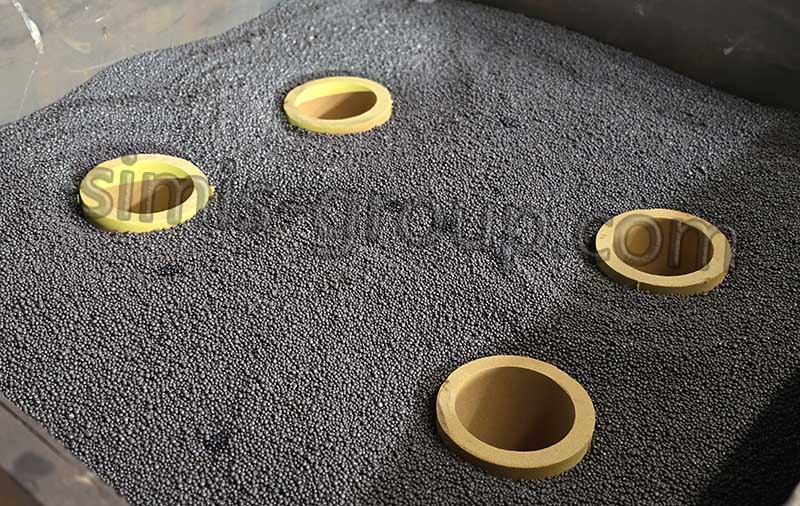
Which Casting Processes Use Gates and Risers?
Different casting processes have different requirements for gates and risers due to differences in filling pressure, mold material, and product quality requirements. As an engineer, it is necessary to clarify the application rules of gates and risers in various processes to ensure the rationality of process design.
Casting processes that use both gates and risers (mainstream application scenarios)
·Sand casting (green sand casting, resin sand casting):
The most widely used casting process, suitable for castings of various sizes and materials. Gates are used to control filling, and risers are used to compensate for shrinkage. For example, heavy-duty machinery bases, large gear blanks, and other castings all adopt this combination.
·Investment casting (lost wax casting):
Suitable for precision castings with complex shapes and high dimensional accuracy. Gates are designed as thin-walled channels to ensure uniform filling, and small blind risers are set at the thick-walled parts to avoid shrinkage defects, such as aerospace engine parts, precision gears.
Using metal molds for casting, suitable for medium-sized aluminum alloy and copper alloy castings. Gates are set at the bottom or side to fill smoothly, and risers are set at the top to compensate for shrinkage, such as aluminum alloy cylinder heads.
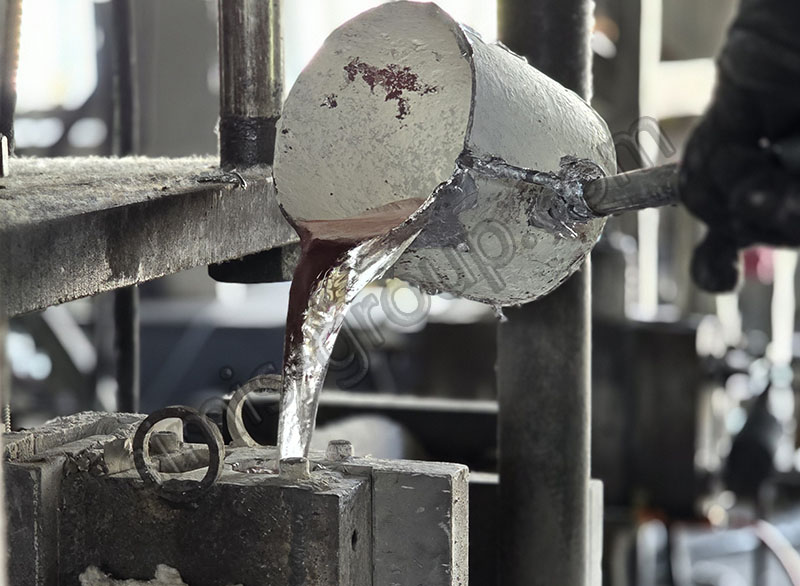
Casting processes that use gates but rarely use risers
·High-pressure die casting (HPDC):
The molten metal is filled into the mold cavity at high speed and high pressure (filling pressure up to 100-200MPa). The high pressure can continuously compensate for the shrinkage of the molten metal during solidification, so risers are generally not used. Gates are designed as narrow channels to increase filling speed, suitable for mass-produced small and medium-sized castings, such as automotive interior parts, electronic product shells.
·Low-pressure die casting:
The molten metal is filled into the mold cavity under low pressure (filling pressure 0.1-0.5MPa). The pressure can compensate for shrinkage, so risers are rarely used. Gates are set at the bottom to ensure smooth filling, suitable for aluminum alloy wheels, cylinder blocks, and other castings.
·Centrifugal casting:
The mold rotates at high speed, and the molten metal is thrown to the mold wall by centrifugal force to form castings. The filling process is controlled by centrifugal force, and the shrinkage is compensated by the continuous flow of molten metal, so gates are simple and risers are not needed, suitable for pipe, sleeve, and other cylindrical castings.
·Continuous casting:
Used for mass production of steel billets, aluminum billets, etc. The molten metal is continuously filled into the crystallizer through the gate, and the solidification process is continuous, so risers are not needed, and the gate is designed as a continuous flow channel.
Casting processes with simplified gating and minimal risering
Investment casting for small precision parts:
The casting size is small (generally less than 50mm), the wall thickness is uniform, and the shrinkage is small. The gate is designed as a thin-walled sprue, and risers are rarely used, or small blind risers are used to ensure the quality of key parts.
The mold has good thermal insulation performance, the molten metal solidifies uniformly, the gating system is simplified, and risers are only used for thick-walled parts.
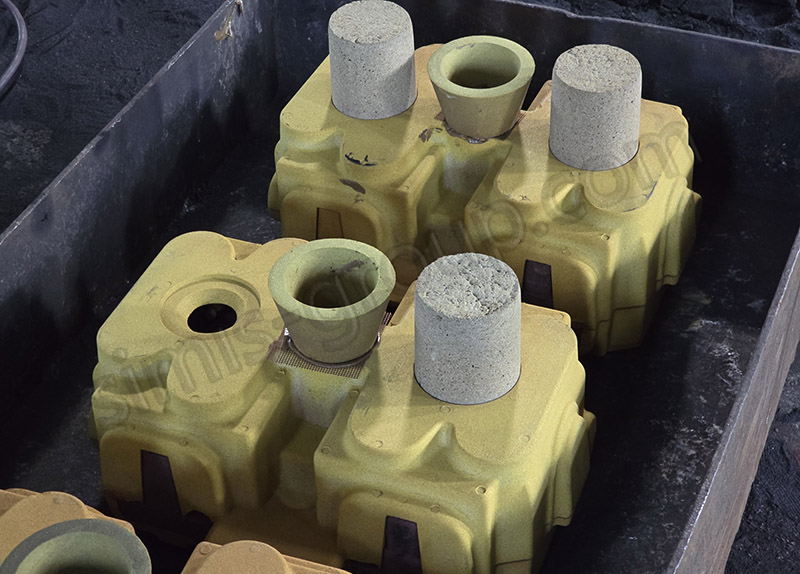
How Do Gates and Risers Affect Casting Defects?
In casting production, more than 40% of casting defects are related to improper design of gates and risers. From an engineering perspective, the design of gates and risers directly affects the filling state, solidification sequence, and feeding effect of molten metal, and further leads to various defects. Below, we analyze the common defects caused by improper design of gates and risers and their prevention measures.
Defects caused by poor gating design and their solutions
·Slag inclusions:
The main cause is that the gate speed is too fast, leading to molten metal turbulence, which entrains slag and dross into the mold cavity; or the gate is set too high, and the molten metal splashes and mixes with slag.
Solution: Optimize the gate cross-sectional size to control the filling speed within the optimal range; set a slag trap at the gate to filter slag and dross; adopt bottom gating or side gating to reduce splashing.
·Porosity and blowholes:
The main cause is that the molten metal fills turbulently, entraining air into the mold cavity; or the gate is too small, the filling time is too long, and the molten metal cools and solidifies before the air is exhausted.
Solution: Optimize the gate shape to ensure laminar filling; increase the gate cross-sectional size to shorten the filling time; set exhaust channels at the gate and the highest point of the mold cavity.
·Cold shuts and misrun:
The main cause is that the gate is too small, the filling speed is too slow, and the molten metal cools and solidifies before filling the entire mold cavity; or the gate is set unreasonably, leading to uneven filling.
Solution: Increase the gate cross-sectional size to improve the filling speed; adopt multi-point gating to ensure uniform filling; preheat the mold and gate to reduce the cooling rate of molten metal.
·Uneven filling and distortion:
The main cause is that the gate position is unreasonable, leading to uneven filling speed of each part of the mold cavity, and uneven cooling and shrinkage of the casting.
Solution: Optimize the gate position to ensure synchronous filling of each part; adopt symmetric gating for symmetric castings; control the filling speed to avoid local overheating.
Defects caused by poor or missing risers and their solutions
·Shrinkage cavities:
The main cause is that the riser volume is too small, the feeding amount is insufficient; or the riser position is unreasonable, failing to feed the thick-walled part of the casting; or the riser solidifies before the casting, losing the feeding function.
Solution: Calculate the riser volume according to the casting volume and alloy shrinkage rate; set the riser at the thickest part of the casting to ensure directional solidification; adopt thermal insulation risers to extend the solidification time of the riser.
· Center porosity:
The main cause is that the riser feeding pressure is insufficient, and the shrinkage of the central part of the thick-walled casting cannot be compensated.
Solution: Increase the height of the riser to improve the feeding pressure; adopt multiple risers for large thick-walled castings; optimize the casting structure to reduce the thickness difference.
·Internal voids:
The main cause is that the riser is missing or the design is unreasonable, and the shrinkage of the casting cannot be compensated.
Solution: Add risers according to the alloy shrinkage rate and casting thickness; adjust the riser position to ensure effective feeding.
·Shrinkage cracks:
The main cause is that the riser design is unreasonable, leading to uneven cooling and shrinkage of the casting, and excessive internal stress.
Solution: Optimize the riser design to ensure uniform solidification of the casting; adopt heat treatment after casting to eliminate internal stress; adjust the casting structure to avoid stress concentration.
Engineering practice shows that reasonable design of gates and risers can reduce the casting scrap rate by 30%-50%, and improve the mechanical strength of castings by 10%-15%. Therefore, in the casting process design, it is necessary to combine the alloy properties, casting structure, and process type to carry out precise design of gates and risers.
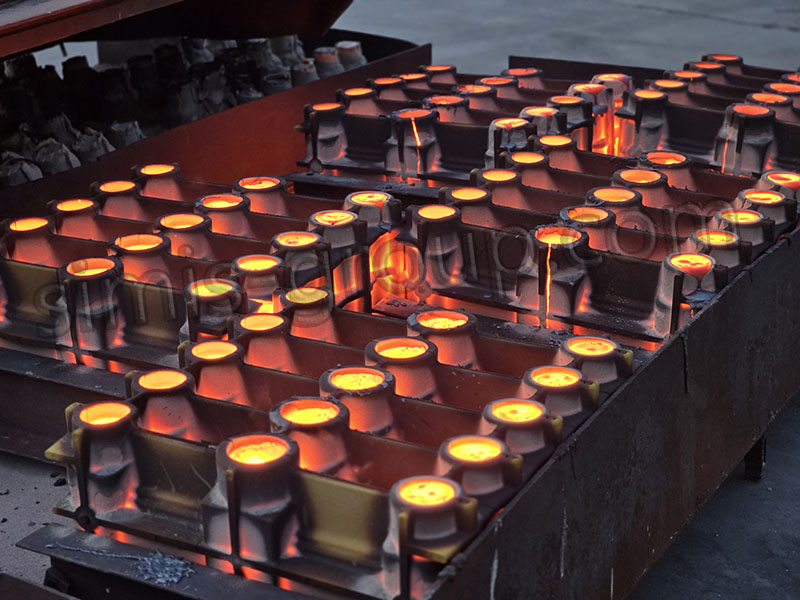
What Are the Differences Between Gates and Risers?
In engineering practice, it is crucial to clarify the differences between gates and risers to avoid design errors. The following table compares the core parameters, functions, design principles, and application characteristics of gates and risers from a professional perspective, which can be used as a reference for process design.
| Comparison Index | Gate (Ingate) | Riser (Feeder) |
| Core Function | Guide molten metal to fill the mold cavity smoothly; control filling speed and direction; reduce turbulence and oxidation. | Compensate for volumetric shrinkage of molten metal during solidification; prevent shrinkage cavities, porosity, and other defects; assist in exhaust. |
| Design Principle | Match the filling speed with the alloy fluidity; ensure uniform filling; avoid turbulence and slag entrainment; easy to remove after casting. | Follow the principle of directional solidification; ensure that the riser solidifies after the casting; sufficient volume and feeding pressure; easy to remove after casting. |
| Key Design Parameters | Cross-sectional shape (rectangular, circular), cross-sectional area, length, position, number of gates. | Volume, height, cross-sectional shape (circular, square), position, type (top, side, blind, open). |
| Material Requirements | No special material requirements; consistent with the gating system, generally made of the same alloy as the casting. | No special material requirements; consistent with the casting, some thermal insulation risers can be added with thermal insulation materials to extend solidification time. |
| Necessity in Casting | Necessary for most casting processes (except for a few special processes such as centrifugal casting with simple structure). | Not necessary; determined by alloy shrinkage rate, casting thickness, and process type. |
| Impact on Casting Quality | Affects surface quality, internal gas content, and dimensional accuracy of castings; improper design leads to slag inclusions, blowholes, cold shuts, etc. | Affects surface quality, internal gas content, and dimensional accuracy of castings; improper design leads to slag inclusions, blowholes, cold shuts, etc. |
| Typical Application Scenarios | All casting processes that require filling molten metal into the mold cavity, such as sand casting, die casting, investment casting. | Sand casting, investment casting, gravity die casting of high-shrinkage alloys (carbon steel, ductile iron, aluminum alloy) and thick-walled castings. |
How Does SIMIS Group Apply Gates and Risers in Casting Processes?
As a professional casting and forging manufacturer with years of engineering practice, SIMIS Group has rich experience in the design and application of gates and risers, integrating professional process design with actual production needs to ensure the quality and stability of castings. SIMIS Group’s casting business covers sand casting, investment casting, gravity die casting, and other processes, mainly serving automotive, EV, machinery, and other industries, providing high-quality castings and professional technical solutions.
In the casting process practice of SIMIS Group, the design of gates and risers adheres to the principle of "precision matching, quality first", and combines the characteristics of different alloys and castings to carry out personalized design:
·For carbon steel and ductile iron heavy castings (such as machine bases, gear blanks), SIMIS adopts bottom gating to ensure smooth filling, and sets top thermal insulation risers at the thickest parts to compensate for shrinkage, which effectively reduces the scrap rate caused by shrinkage defects to less than 5%;
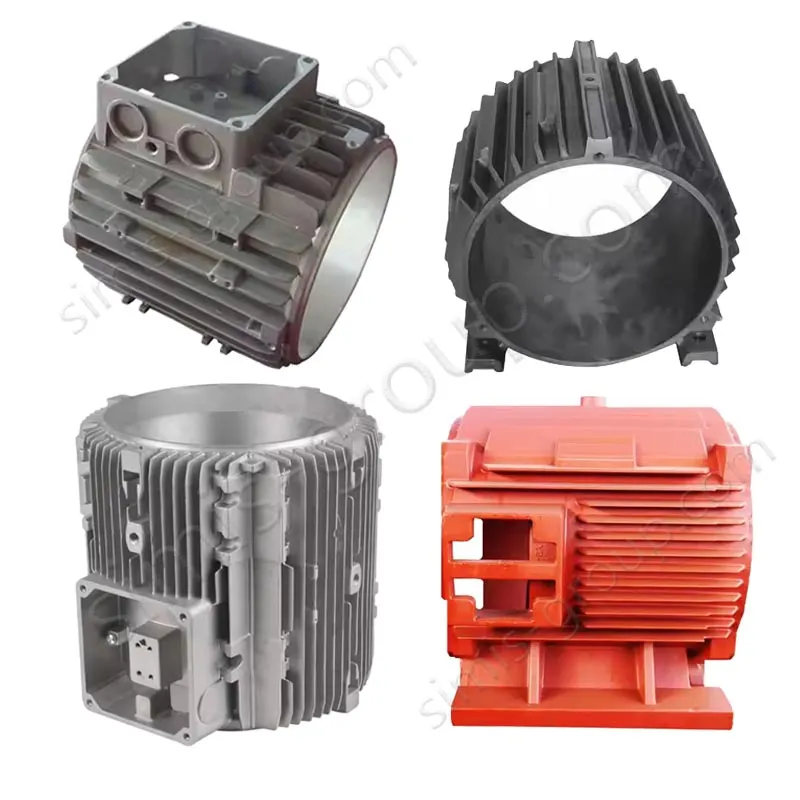
·For aluminum alloy EV parts (such as battery cases, motor housings), SIMIS adopts side gating or bottom gating, and combines low-pressure die casting process to avoid risers, relying on high-pressure feeding to ensure the internal quality of castings, and the dimensional accuracy of castings reaches CT7-CT8 level.
SIMIS Group is equipped with a professional casting process design team, which uses casting simulation software (ProCAST) to simulate the filling and solidification process of molten metal, optimize the design parameters of gates and risers, and avoid design errors in the early stage. At the same time, SIMIS adheres to ISO 9001 and IATF 16949 quality management systems, strictly controls the quality of each link from raw material selection to casting forming, and conducts non-destructive testing (ultrasonic testing, X-ray testing) on castings to ensure that the castings meet the engineering application requirements.
For custom casting projects, SIMIS Group’s technical team will conduct in-depth communication with customers to clarify the casting material, structure, performance requirements, and application scenarios, and design reasonable gate and riser schemes according to the actual needs, providing one-stop solutions from process design, prototype production, mass production to after-sales service, which has been recognized by customers in various industries.
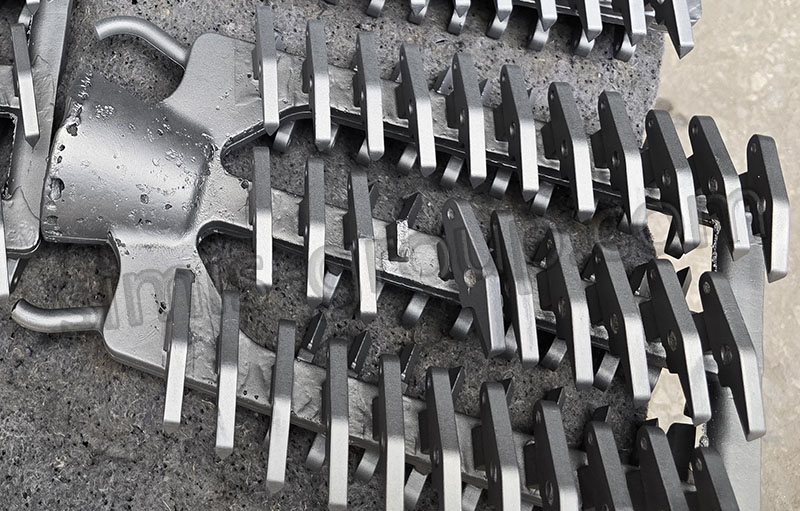
What Is the Practical Engineering Example of Gates and Risers in Casting?
Combining engineering practice, we take two typical casting cases to elaborate on the application of gates and risers, so as to provide more intuitive reference for engineering and procurement personnel.
Case 1: Carbon steel heavy machine base (sand casting)
Casting parameters: Material is Q235 carbon steel, weight 500kg, maximum wall thickness 40mm, dimensional accuracy requirement CT9.
Process design: Adopt side gating (cross-sectional area 80mm×20mm) to ensure uniform filling, avoid turbulence and slag entrainment; set two top thermal insulation risers (diameter 150mm, height 200mm) at the thickest part of the machine base, and the riser volume is 12% of the casting volume to ensure sufficient feeding; set a slag trap at the gate to filter slag and dross.
Production effect: The casting has no shrinkage cavities, porosity, or other defects, the mechanical properties meet the requirements (tensile strength ≥375MPa), and the scrap rate is 3%.
Case 2: Aluminum alloy EV battery case (low-pressure die casting)
Casting parameters: Material is 6061 aluminum alloy, weight 30kg, wall thickness 8-12mm, dimensional accuracy requirement CT8.
Process design: Adopt bottom gating (cross-sectional diameter 30mm) to fill smoothly, reduce oxidation and gas entrapment; no risers are used, relying on low pressure (0.3MPa) to compensate for the shrinkage of molten metal during solidification; set exhaust channels at the top of the mold cavity to ensure complete exhaust.
Production effect: The casting surface is smooth, the internal porosity is less than 1%, the dimensional accuracy meets the requirements, and it is suitable for EV battery packaging.
What Is the Relationship Between Gates and Risers in Casting Engineering?
In casting engineering, gates and risers are complementary and independent, and together form the auxiliary system of the casting process. Their core relationship can be summarized as follows:
First, they have different functions and are indispensable in their respective application scenarios—gates are responsible for "filling", ensuring that molten metal can smoothly enter the mold cavity; risers are responsible for "feeding", ensuring that the casting does not produce shrinkage defects.
Second, they are closely coordinated and affect each other—reasonable gate design can ensure uniform filling, create favorable conditions for the feeding of risers; reasonable riser design can compensate for shrinkage, and avoid the impact of shrinkage on the quality of the casting caused by improper gate design.
In some special casting designs, the gate and the riser can also be combined—for example, in small castings, the riser can be used as a part of the gating system, and while feeding, it can also assist in filling. However, in most engineering cases, gates and risers are designed separately to ensure that their respective functions are fully exerted. In addition, both gates and risers are auxiliary structures, which need to be removed after casting and recycled, so their design also needs to consider the difficulty of removal and material utilization rate, so as to reduce production costs.
What Are the Key Points for Engineering Personnel to Design Gates and Risers?
For engineering personnel engaged in casting process design, the key points of gate and riser design are as follows:
·First, master the shrinkage characteristics of different alloys, and determine whether risers are needed according to the shrinkage rate;
·Second, combine the casting structure and wall thickness to determine the position, size, and type of gates and risers, ensuring that the filling is uniform and the feeding is effective;
·Third, use casting simulation software to simulate the filling and solidification process, optimize the design parameters, and avoid design errors;
·Fourth, combine the casting process type, and adjust the gate and riser design according to the characteristics of different processes (such as no risers in high-pressure die casting);
·Fifth, consider the actual production conditions, such as the difficulty of mold manufacturing, the difficulty of casting cleaning, and material utilization rate, to ensure that the design scheme is feasible.
Conclusion
Gates and risers are core auxiliary structures in casting engineering, and their design level directly determines the quality, yield, and cost of castings. As engineering personnel, it is necessary to clearly understand the definition, functional principles, and design requirements of gates and risers, clarify the differences and connections between them, and combine the alloy properties, casting structure, and process type to carry out precise design.
Gates are the "entry path" of molten metal, responsible for smooth filling; risers are the "feeding reserve" of molten metal, responsible for compensating shrinkage. A gate does not always require a riser, which depends on the alloy shrinkage rate, casting thickness, and process type. Improper design of gates and risers will lead to various casting defects, while reasonable design can significantly improve casting quality and reduce scrap rate.
China SIMIS Group’s casting process practice shows that professional gate and riser design, combined with advanced simulation technology and strict quality control, can effectively ensure the stability and reliability of castings. For castings used in automotive, EV, machinery, and other fields, it is crucial to choose a professional manufacturer with rich engineering experience to carry out process design and production, so as to meet the high-quality requirements of engineering applications.